
Learning to surf is not only about paddling harder or perfecting your pop-up. A big part of becoming a better surfer is learning how to read waves before they reach you.
When you can recognise where a wave will break, which direction it will travel, and whether it is worth paddling for, you can position yourself more effectively and make better decisions in the water. Instead of reacting at the last second, you begin to anticipate what the ocean is doing.
Wave reading takes time to develop, but understanding a few basic principles can make your next surf session much easier.
What Does It Mean to Read Waves?
To read waves means observing a wave and predicting how it is likely to behave as it approaches shallower water.
Surfers look for clues such as the wave’s shape, highest point, direction, and unbroken sections. They also pay attention to larger surf conditions, including swell direction, tide, wind, and the shape of the ocean floor.
The goal is not to predict every wave perfectly. Instead, you want to recognise patterns early enough to decide where to paddle, where to take off, and which direction to ride.
Learn the Basic Parts of a Wave
Before trying to predict a wave, it helps to understand what you are looking at.
The peak is the highest and usually steepest part of the wave. It is often the first section to break and an important reference point when choosing your take-off position.
From the peak, look towards the shoulder, which is the unbroken face extending away from the breaking section. This is the part surfers generally want to ride along.
The lip is the upper edge of the wave that pitches or falls forward as the wave breaks. Once it crashes down, it creates whitewater, or the foamy water moving towards shore.
You should also recognise the impact zone, where the lip repeatedly lands with the greatest force. Understanding where this area sits can help you choose a better route when paddling out.
Read Waves by Identifying Their Direction
One of the first skills beginners should practise is recognising whether a wave is going left, right, both ways, or closing out.
Right and Left Waves
Wave direction is named from the surfer’s perspective while riding towards shore.
A right-hand wave breaks so the surfer can travel to their right. A left-hand wave gives the surfer an open face to their left.
From the beach, these directions can appear reversed, which is why beginners sometimes find them confusing. Try imagining yourself standing on the board and facing the shore.
A-Frame Waves
An A-frame has a defined peak with open shoulders on both sides. One side breaks left and the other breaks right.
These waves can offer two possible riding directions, although surfers still need to respect priority and surf etiquette before taking off.
Closeouts
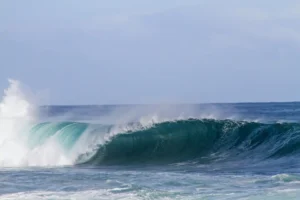
A closeout occurs when most or all of the wave breaks at roughly the same time rather than peeling gradually from one section to another.
If the entire wave face becomes steep along a relatively straight line with no obvious open shoulder, it may be about to close out. For beginners trying to practise riding along the face, these waves usually offer very little time to turn and continue down the line.
Source: Unsplash
Find the Peak Before You Start Paddling
Once you can recognise basic wave shapes, start looking for the peak.
Watch the horizon as a swell approaches. Instead of immediately paddling towards every incoming wave, look for the section that begins to rise higher and become steeper than the surrounding water.
That area will often break first.
Identifying it early gives you more time to adjust your position. Ideally, you want to be close enough to catch the wave while still having access to an open shoulder.
Avoid focusing only on where other surfers are sitting. Sandbars, tides, swell direction, and other conditions can shift the best take-off position throughout a session.
Look at the Shoulder to Predict How the Wave Will Break
Finding the peak tells you where a wave may start breaking. Looking at its shoulders helps you understand what happens next.
Ask yourself: which side still has an open, rideable face?
A clearly defined shoulder extending away from the peak usually gives you a better opportunity to ride along the wave. The shape and angle of that shoulder can also give clues about how quickly the wave may peel.
If the wave appears to stand up across its entire width without a clear shoulder, there is a greater chance that it will close out.
With experience, you will begin making this assessment within seconds.
Observe the Ocean Before Paddling Out
One of the easiest ways to improve your ability to read waves happens before you even enter the water.
Spend around five to ten minutes watching the surf from shore. Notice where waves consistently begin to break, how frequently larger sets arrive, and whether surfers are moving position when those sets appear.
Look for patterns rather than judging conditions from one wave.
You can even practise “surfing” from the beach. Pick an approaching wave and predict where you would paddle, where you would take off, and whether you would go left or right. Then watch how the wave actually breaks.
This simple exercise helps train your eye without the pressure of simultaneously paddling, balancing, and competing for position.
Understand How Surf Conditions Change Waves
Knowing how to read waves also means recognising that the same surf spot can behave very differently from one day to another.
Swell direction affects the angle at which waves approach the coastline, while swell period influences the energy carried by incoming swell. Longer-period swell can carry substantial energy and may behave differently from shorter-period local wind swell.
Tides change water depth over reefs, rocks, and sandbars. As a result, a break that works well at one tide may become too shallow, too deep, faster, or less defined at another.
Wind matters too. Offshore wind, which blows from land towards the ocean, can help keep wave faces cleaner, while strong onshore wind often creates choppier and less organised conditions.
Finally, the ocean floor, or bottom contour, plays a major role in determining where and how waves break. Reefs, sandbars, and underwater features can all influence wave shape, direction, and consistency.
Because these factors interact, avoid relying on a single number from a surf forecast. Compare the forecast with what you can actually see at the beach.
Practise Reading Every Wave
The fastest way to improve is to make wave reading an active part of every session.
Before paddling for an approaching wave, quickly ask yourself: Where is the peak? Which shoulder is open? How quickly is it breaking? Where should I position myself?
You will get some predictions wrong, especially at first. That is part of developing the skill. Pay attention to what the wave actually does and compare it with what you expected.
Over time, these observations become increasingly automatic.
Read Waves Better, Surf Smarter, and Get the Expert Surfing to taste Your Surf in Bali
Learning to read waves can transform the way you approach surfing. Start with the fundamentals: identify the peak, recognise the open shoulder, distinguish rights and lefts, and learn to spot potential closeouts. Then add your understanding of swell, wind, tide, and the characteristics of your local surf spot.
Most importantly, give yourself time to observe. Spend a few minutes watching the ocean before each session and continue analysing waves even when you are not the surfer catching them. The more waves you watch, the easier it becomes to recognise patterns, choose better positions, and make more confident decisions in the water.
And when you are ready to put those skills into practice, Flow State Bali gives you the chance to experience Bali’s waves and spend more time doing what matters: surfing coach, learning surfing, and enjoying the ocean. Take what you have learned into the water, sharpen your skills with every session, and make Flow State Bali part of your next surfing adventure in Bali.